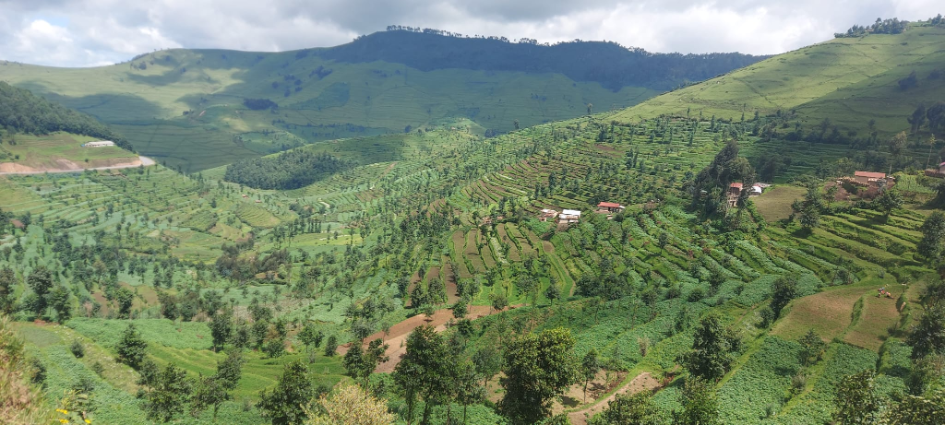
Restoration landscape in Rwanda’s Western Province. Image: Clémence Mukankuriza
This article was collaboratively written by: Emma Marie Niyigena, Delphine Mpayimana, Clémence Mukankuriza, Jeannette Uwitonze, Pacifique Niyodushima, Anatholia Mizero, Faustin Mbarubukeye, and Laura Kmoch.
. . .
Which benefits do rural people derive from restored sites? Which emotions — good and bad — do they associate with different intervention types? How do they feel about encountered challenges, and what could be improved?
We are about to find out, through our latest data collection round in Rwanda’s western highlands. A photo-elicitation survey was our tool to engage residents from 35 villages in structured conversations about three restoration types: agroforestry, woodlots and terraces.
It’ll take a while until we can share the full results of our statistical analysis. Our respondents’ first-hand accounts moved the entire enumerator team, however, and triggered reflections. Read on for their stories of what stood out.
. . .
My name is Emma Marie Niyigena. I work as an enumerator for the RESTORE research project in Western Rwanda. My job is to talk with people in different communities, and to learn how land restoration is changing their lives.
I have been interviewing locals about woodlots, agroforestry, and terraces. Only a few people shared challenges — most of them expressed joy, because these activities increase their productivity and bring both food and cash crops to their families.
Emma Marie, engaged with an interviewee (left), landscape with forest, tea, and pastures in the study area (middle), maize snack sweetening the team’s long drive (right). Images: Clémence Mukankuriza and Emma Marie Niyigena.
We listen to their stories, understand their challenges, and collect information that helps guide better solutions. This work supports efforts to bring back healthy soil, protect the environment, and improve livelihoods for the future.
Sadly, I was usually rushing to the next interview. And also, the routes were tough sometimes, far from the main road and slippery with rain. But the smiles, stories, and teamwork made it worth it. And the nice moments with the team after work, when we used to buy roasted maize and laughed over the day’s adventures and shared the day’s stories.
. . .
This is the third week of my data collection on how terraces, woodlots and agroforestry trees support rural livelihoods. Every day is a good day — I never get used to how rural people are overwhelmed to welcome us, with smiles on their faces, excited to have an open conversation on the research.
Good enough, many of them want to see more restoration practices in their farmlands, because they have seen how beneficial they are. Due to those restoration practices, a lot has changed and a lot still needs to be done as they said in their responses.
. . .
As a research enumerator, I thought I understood restoration. Yes, I had seen it in action: Farmers building terraces, planting trees on bare hills, digging trenches to fight off erosion, bending their backs day after day to care for land that gives so much and asks for more.
At first, I didn’t understand. But then he pointed to the road above his plot — cracked, unpaved, and built without drainage. Every rainy season, it sends torrents of water roaring down the hill, flooding his terraces, sweeping away soil, and undoing years of backbreaking work.
Terraced farmland — maintained through smallholders’ hard work (left), Clémence in dialogue with a respondent (middle), team members crossing a bridge — this stream will greatly swell during the rainy season (right). Images: Clémence Mukankuriza and Laura Kmoch.
Also, he wasn’t just speaking for himself. He was voicing what so many rural farmers feel — that they are praised when things go well, but left alone when the system fails them.
This experience challenged everything I thought I knew. Restoration isn’t just about planting trees or digging terraces — it’s about systems, decisions, and accountability. It’s about listening to farmers’ lived realities, not just policies on paper.
. . .
Jeannette: How agroforestry benefits farmers and the environment
It was fantastic to speak with farmers, with experiences in various restoration techniques! They talked about their feelings after learning about various types of restoration, such as terraces, agroforestry, and how they help to maintain their livelihoods:
.
Homegarden in Rutsiro District (left), Jeannette in dialogue with a survey respondent (middle), sheep of a hillside farm (right). Images: Jeannette Uwitonze and Laura Kmoch.
The trees provide shade, stakes used to support agricultural crops, firewood, and on terraces they got fodder for livestock, and they keep the soil moist. The additional income from selling timber, fruits, and other tree products has significantly improved their family’s livelihood and reduced financial risks.
. . .
My name is Pacifique Niyodushima — a Masters student in environmental economics and natural resources management. I was honored to be among the enumerators collecting primary data on the livelihoods of local people living in restoration areas in western Rwanda, under research being carried out by University of Göttingen in Germany.
Cows on a silvo-pasture in northern Rutsiro District (left), Pacifique during an interview with a respondent from Nyabihu District (right). Images: Jeannette Uwitonze and Delphine Mpayimana.
I learned from the respondents how they perceived restoration projects in their initial stages, and how their perceptions have changed so far. By taking terraces as an example, in the early stages most of the people were unaware of the importance of terracing, but now it is totally different. Mainly due to the benefits they experienced from this type of restoration.
. . .
A woodlot is a parcel of woodland, mainly used for land restoration because of its capacity to prevent soil erosion, and for its main products — fuel wood and timber for building. Today I visited Rugari Cell, where I saw how beneficial woodlots are for the farmers. For example, they derive wood fuel, timber, leave mulch as fertiliser, and food for their livestock.
The challenges that the respondents met were that people in this area have planted many small woodlots, with tree seeds that they received from the government. But they planted those trees in their land for agriculture— where these trees take much water, and crops around them can’t grow — rather than on the hilltop. This leads to people gaining lower amounts of crops from their cultivation.
. . .
During the July/August 2025 survey most of the respondents acknowledged that the most effective approaches to soil restoration and conservation include: agroforestry, terracing, and woodlot establishment.
Furthermore, the respondents expressed satisfaction with the discussions held during the survey process and indicated that they would appreciate future visits.
. . .
At the end of our research stories lies this bridge: We invite you to cross it, to explore the restoration landscapes of Western Rwanda for yourself. The roads were not always easy — more than once we continued on foot. But kindness and thoughtful conversations always lay ahead. Image: Laura Kmoch.
Successful data collection depends on more than choosing the right method. It’s just as much about the group experience of the research team — the shared learning, growth, and quiet strength, arising when people with diverse skills and personalities collaborate.
Thanks to the entire team — including our dependable drivers, the survey respondents who shared their time and knowledge, and many people, from cleaning to kitchen staff in the hotels, who cared for us — we can now dive into the analysis of our survey data. Stay tuned!
. . .
Further reading:
For details about the RESTORE project, visit our website: https://ecosystemrestoration.net/
An earlier blog post, on how we used photovoice to explore rural people’s restoration experiences, can be found here: https://ecosystemrestoration.net/tag/sp6/
Additional stories about forest-related research of the social-ecological interactions group can be found here: https://medium.com/people-nature-landscapes/forestday-f24dced220c5
Left Figure: Mukura National Park. Photo by Marina Frietsch.
Right Figure: Gishwati National Park. Photo by Marina Frietsch
By Molly Parker, on Reckmann et al., A coffee corridor for biodiversity and livelihoods: climatic feasibility of shade coffee cultivation in western Rwanda, 10.1016/j.tfp.2025.100941 (full citation at the bottom of this post).
In the Gishwati–Mukura Landscape of western Rwanda, ongoing agricultural expansion and deforestation are placing increasing pressure on an already fragile ecosystem. Once part of the vast Afromontane rainforest, this area has become highly fragmented due to decades of land-use change, population growth, and conflict. Now, it is split into two disconnected forest patches, separated by approximately 30 km of smallholder farmland.
These forests are under strain not only ecologically, but economically as well, raising an urgent question: how can farmers earn a sustainable income without further degrading this unique and threatened landscape?
A new study by Reckmann et al. (2025) explores whether shade-grown coffee could provide part of the answer.
The study focuses on three core questions:
Using climate suitability analysis, the researchers assess where this type of agroforestry system could thrive today and how that might shift in the coming decades. They also identified native species that could be used as shade trees in the area. The results suggest that it’s possible to establish a “coffee corridor” made up of climate-resilient, tree-shaded coffee farms that could link fragmented habitats, promote biodiversity, and support rural livelihoods.
Why is this important?
With climate change, climatic suitability for Coffea arabica cultivation in the study area will increasingly shift upwards in the coming decades making shade coffee production increasingly viable. In agreement with the findings of this study, increased temperatures and especially maximum temperatures are understood to be major drivers of this uphill shift. The overall effect of this in coffee suitability across the global coffee sector will likely also apply to Rwanda.
Creating a shade coffee corridor between Gishwati and Mukura forest patches could provide the study area with a boost in livelihood opportunities as well as biodiversity conservation perspectives. In terms of biodiversity benefits, incorporating native trees to the canopy could offer a wealth of opportunity including increased diversity, carbon sequestration, habitat provision, soil protection, soil fertility, erosion control, and more. Shade coffee plots could ultimately become a wildlife corridor helping to facilitate the movement of diverse species between the Gishwati and Mukura forest patches.
But the corridor’s success is conditional: it will only be viable if it offers tangible benefits to local farmers, which is something that aligns with national policy. Encouragingly, the Rwandan government supports the cultivation of Coffee arabica, recognizing its potential to reduce poverty and provide sustainable economic opportunities.
As smallholder farmers will be the primary cultivators, their input is critical for the adoption and long-term viability of the project. It is important that coffee cultivation is integrated into the existing livelihood activities in a way that is helpful for the farmers.
Moving forward:
Reckmann et al.’s findings suggest that a shade coffee corridor between Gishwati and Mukura forest patches could reconcile livelihood security and biodiversity conservation. They recognize the importance of prioritizing the local communities’ needs, and actively sharing knowledge when applicable and relevant.
A possible next step could be a continuation of the identification of suitable tree species for the shade corridor. Although much research has been completed, the researchers recognize that local knowledge is also essential and highly valuable. They suggest a transdisciplinary action such as a living lab in order to get communities involved and engaged. Using the research completed as guidance for implementation, practitioners and policy makers can also look to existing initiatives .
In a cautiously hopeful conclusion, Reckmann et al. state: “ With climate change being inevitable and restoration being a high priority for the Rwandan government, the coffee corridor proposed in this paper should be carefully considered as a possible win-win for people and ecosystems.”
Citation:
Reckmann, T., Frietsch, M., Schwenck, C., Mukuralinda, A., Duguma, D. W., & Fischer, J. (2025). A coffee corridor for biodiversity and livelihoods: Climatic feasibility of shade coffee cultivation in western Rwanda. Trees, Forests and People, 21, 100941. https://doi.org/10.1016/j.tfp.2025.100941
We are pleased to announce the upcoming Global Conversation 2025, hosted by the Social-Ecological Systems Institute, taking place on June 5th at 2:00 PM CEST. This year’s discussion will focus on the theme:
Regeneration – An Emerging Paradigm for Social-Ecological Systems.
The event will feature a diverse panel of international experts who bring insights from research, policy, and practice:
Speakers:
– Prof. Steffen Farny, Institute for Management & Organization, Leuphana University of Lüneburg
– Dr. Victoria Gutierrez, Head of Global Policy, Commonland
– Dr. Caitlin McElroy, Smith School of Enterprise and the Environment, University of Oxford
Moderators:
– Prof. Joern Fischer, Social-Ecological Systems Institute, Leuphana University of Lüneburg
– Dr. Manuel Pacheco-Romero, Social-Ecological Systems Institute, Leuphana University of Lüneburg
We look forward to a rich and inspiring exchange with participants from across disciplines and regions.
The flyer with all details is available here
To register you can click here
In February 2025, a meeting in Kigali was organized by our research group to share diverse insights on social-ecological restoration among a range of different organizations representing both research and practice. The meeting resulted in seven concrete recommendations for improved restoration practice in Rwanda. These recommendations have been shared with policymakers in the position paper attached to this blog post.
Briefly, the seven recommendations are:
Recommendation 1: Efforts to use native species in restoration must be greatly increased
Recommendation 2: Homegardens must be included in restoration strategies because they are pivotal for both nutrition and biodiversity
Recommendation 3: Science can help to guide the development of a sustainable corridor from Nyungwe NP to Gishwati-Mukura NP and Volcanoes NP
Recommendation 4: Short-term and long-term considerations are needed to enhance livelihoods and nutrition
Recommendation 5: Genuine community involvement is important at all stages of restoration, from planning to monitoring
Recommendation 6: The best available science must be used to evaluate restoration policy and practice
Recommendation 7: A shift in mindsets is required to move away from simple metrics of ‘trees planted’ to a culture of collectively growing ecosystems that will benefit people and biodiversity
Some of these recommendations will not come as a surprise to those who have been engaged in restoration science and practice for many years. However, even these ‘obvious’ aspects of good restoration practice are not always adhered to when various real-world constraints shape and limit what happens on the ground. In other words: even (and especially!) the obvious recommendations deserve attention because despite them being widely known, they still are not always implemented on the ground.
Other recommendations are far less obvious: for example, the potential importance of homegardens for biodiversity conservation and restoration remains relatively little appreciated by many people who are active in restoration.
We share our position paper and its seven recommendations in a spirit of fostering constructive dialogue on how to further improve restoration outcomes for both people and biodiversity in Rwanda. A big thank you to all the organizations who were involved in putting this together!
Following the Rwanda Restore project kick-off in Kigali in January 2024, and a restoration stakeholder conference held in Kigali from February 19 to 21, 2025, the “living lab for social-ecological restoration in western Rwanda” sub-project of the “A Social-Ecological Systems Approach to Inform Ecosystem Restoration in Rural Africa” DFG Research Unit, Kicked-off the Living Lab in Rutsiro District, western Rwanda on February 25th, 2025. 42 participants attended the workshops from academia (Center of Excellence in Biodiversity and Natural Resource Management of the University of Rwanda and the Rwanda Polytechnic-Kitabi College), various governmental (Rwanda Water Resources Board, Rwanda Forestry Authority, Rwanda Agriculture Board and Rutsiro District), and non-governmental institutions (IMBARAGA Farmer Association, Forest of Hope Association, ARECO Rwandanziza, World Resource Institute -Rwanda, World Vision, Rwanda Organic Agriculture Movement, Albertine Rift Conservation Society, One Acre Fund, SNV-Rwanda, Center for International Forestry Research and World Agroforestry-Rwanda) and local communities (Rutsiro Tea Growers Cooperative, farmer cooperatives, community farmer groups, traditional healers, beekeepers, model farmers in horticulture). The workshops aimed to establish a Living Lab Roundtable and define two governance models for the Living Lab, along with its code of conduct and communication strategy. Also, the workshop discusses opportunities and challenges for the current, mid-term and long-term future of restoration in Rutsiro, using a Three Horizons Approach, for restoration strategic planning in Rutsiro.
Organized into small group discussions, participants defined the code of conduct, communication principles and strategy and the three horizons for the restoration in the area
At the end of the workshop, participants visited Living Lab sites in Gihango Sector. During the visit, the research team hiked through the hilly landscape to observe various land uses and assess the potential for restoration interventions. They were accompanied and guided by local field assistants and farmer group members, who provided valuable insights (see photo reference).
A community workshop was organized in two cells of the Gihango District: Teba and Shyembe. The field trip brought together representatives of farmers groups and cooperatives, carpenters, traditional healers, beekeepers, and farm owners of plots where the Living Lab sites sit.
Individual visits were also arranged to meet model farmers who have enhanced their nutrition by integrating food plants such as Chayote, Passion fruit, Avocado, Pineapple and Cucumber into agroforestry systems, particularly within their home gardens, for their consumption or the market. In some cases, farmers combine a variety of fruit plants and legumes within the same plot. The photos below capture the illustration very well.
The study selection and the social network analysis to identify haVE been completed in year 2024. The roundtable has also now been set up, the ongoing process before the end of this year will cover the co-design of field trials, definition of impact areas, delineation and registration of demonstration sites, including the signing of sustainability agreement with farm owners within the sites where the Living Lab will operate. The Living Lab roundtable of stakeholders will also develop the indicators of success…
Author: William Apollinaire